Buying a property in Spain is a decision most foreign owners plan carefully. What far fewer plan with the same attention is what happens to that property when they die — and that gap can cost their heirs time, money and legal complications that could have been avoided entirely.
Inheritance tax in Spain is one of the most complex fiscal aspects for non-resident property owners. The amount payable depends on the region where the property is located, the heir’s relationship to the deceased, and whether the heir is a Spanish tax resident. Without prior planning, the differences can be substantial.
In this guide from Sol-4 Gestión, we explain how inheritance is taxed in Spain for non-residents, what documents are required, what the legal deadlines are, and how to legally reduce the tax burden before it’s too late to act.
What Is Spanish Inheritance Tax and Who Does It Affect?
The Impuesto sobre Sucesiones y Donaciones (Inheritance and Gift Tax) is the tax levied on the transfer of assets and rights upon death. In practice, it taxes the increase in wealth that heirs receive as a result of an inheritance.
In Spain, this tax is governed by Ley 29/1987, but the autonomous communities (regions) have broad powers to modify rates, reduce the tax base or grant exemptions. This has created significant differences between territories: inheriting in Madrid or Andalusia can mean a radically different tax bill than doing so in other regions.
For the non-resident foreign property owner, there is an additional layer of complexity: even without living in Spain, their heirs are required to settle the tax with the Spanish Tax Agency (Agencia Tributaria) if the inherited estate includes assets located in Spanish territory.
Resident vs. Non-Resident: How It Affects the Tax
The distinction between personal liability and real liability is the first concept to understand.
Personal liability (Spanish tax residents)
Spanish tax residents pay inheritance tax on all assets and rights they receive, regardless of where those assets are located. The rules of the autonomous community where the deceased resided apply.
Real liability (non-residents)
Non-resident heirs, or those inheriting from a non-resident deceased, pay tax only on assets located in Spain. Following significant legal changes — driven by rulings from the Court of Justice of the EU and the Spanish Supreme Court — non-residents are now entitled to apply the rules of the autonomous community where the highest-value Spanish assets are located. This removes the historical discrimination between residents and non-residents, and opens the door to benefiting from the most favourable regional exemptions.
Non-resident heirs who are not resident in an EU member state or European Economic Area country are also required to appoint a fiscal representative with residence in Spain to manage the tax with the Tax Authority.
Tax Groups and Rates
Spanish inheritance tax does not apply the same rate to all heirs. The amount depends on two factors: the tax base (the value of what is inherited) and the relationship group the heir belongs to.
| Group | Heirs included | Key features |
|---|---|---|
| Group I | Children and descendants under 21 | Largest exemptions and allowances |
| Group II | Adult children, grandchildren, spouse, parents | Important reductions; the most common group |
| Group III | Siblings, aunts/uncles, nieces/nephews | Smaller reductions |
| Group IV | Distant relatives and non-family beneficiaries | Highest rates; up to 34% in some regions |
The national tax scale is progressive: it starts at 7.65% for lower bands and can reach 34% for larger inheritances with multiplier coefficients applied for the heir’s pre-existing wealth. Autonomous communities can significantly reduce these rates through their own exemptions and bonifications.
Regional Differences: Why the Property’s Location Matters
One of the most important factors for foreign property owners is that the tax cost of inheriting in Spain varies enormously by autonomous community. Some regions have approved bonifications of 99% for Group I and II heirs, effectively reducing the tax to almost nothing. Others apply the national scale with minimal changes.
The Valencian Community, where the majority of Sol-4 Gestión’s clients own property, has its own framework worth understanding before planning. The reductions available for spouses, children and descendants have varied in recent years, and correctly applying those reductions can mean a difference of tens of thousands of euros on mid-to-high value inheritances.
Specialist advice before a death occurs makes it possible to structure the estate and the will in a way that maximises the available reductions for heirs.
How the Tax Base Is Calculated for Non-Residents
For non-resident heirs, the tax base is calculated only on assets located in Spain. The main assets included are:
- Real estate: any property in Spanish territory, valued at market price at the date of death.
- Bank account balances held in Spanish financial institutions, at the date of death.
- Listed securities: at their market price on the day of death.
- Rights in rem over real estate located in Spain.
From the tax base, debts, charges and documented expenses that reduce the real value of the inherited estate can be deducted. The Tax Agency has the authority to review declared values, so accurate valuation from the outset is important.
The Deadline: Six Months from the Date of Death
This is the figure that catches most foreign heirs off guard — and the one that causes the most problems when it isn’t known in advance.
The inheritance tax return must be filed within six months from the date of death. The form used is the Modelo 650, submitted to the National Tax Management Office of the Agencia Tributaria.
If six months proves insufficient to gather documentation or manage procedures from abroad, it is possible to request an extension of a further six months — but the request must be made within the first five months of the original deadline. Once that window passes, no extension is available and interest begins to accrue.
Six months can sound like enough time. In practice, when foreign documents need apostilling, wills need certified translation, fiscal representatives need appointing and assets need valuing, the time runs out faster than expected.
Documentation Required to Manage an Inheritance in Spain
The Tax Agency requires the following mandatory documentation for the Modelo 650:
- Deed of inheritance acceptance (original and simple copy), or alternatively a double inventory of assets and heirs.
- Copy of the death certificate.
- Copy of the Certificate from the General Registry of Last Wills (Registro de Actos de Última Voluntad), even if it comes back negative.
- Copy of the will or declaration of heirs.
- Copy of the passport, ID or NIE of the heirs and of the fiscal representative in Spain.
Depending on the assets included in the estate:
- Copy of the property tax receipt (IBI) and title deed, or nota simple from the Land Registry.
- Bank certificate showing account balances at the date of death.
- Insurance contracts or insurer’s certificate, if applicable.
Important: documents issued by foreign authorities must be presented with the Hague Apostille and a sworn translation into Spanish.
How to Legally Reduce Inheritance Tax in Spain
There are legal mechanisms that can significantly reduce the tax burden on a Spanish inheritance. The main ones are:
A Spanish will
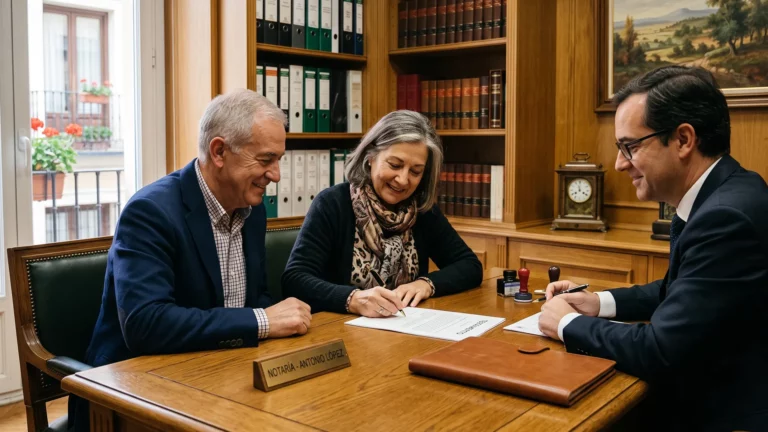
Having a will drawn up before a Spanish notary is the simplest and most effective step. It allows clear designation of heirs, avoids the application of the default legal succession order, and — for EU citizens — enables use of EU Regulation 650/2012 to choose that the succession law of the testator’s country of origin applies. Without this express declaration, Spanish rules apply automatically, including forced heirship provisions.
Choosing the most favourable regional rules
Since non-residents are entitled to apply the rules of the autonomous community where the highest-value inherited Spanish assets are located, selecting the right regional framework can produce meaningful savings. A specialist adviser can calculate which application is most beneficial in each case.
Principal residence exemption
Spouses or children who inherit the deceased’s principal residence may be entitled to a 95% reduction on that asset in the tax base, subject to a retention period for the property. This reduction exists at national level and in most autonomous communities, with variations in limits and conditions.
Prior succession planning
The most effective way to reduce inheritance tax is to act before the death occurs: structuring the estate correctly, valuing assets accurately, designating heirs with fiscal criteria in mind, and drafting a will that maximises available reductions. Once a succession is open, the room for manoeuvre diminishes considerably.
Manage Your Inheritance in Spain with Sol-4 Gestión
If you have inherited a property in Spain, or want to plan the transfer of your estate to protect your heirs, Sol-4 Gestión can help.
Through our inheritance services in Spain, we manage the entire process: from obtaining the NIE and opening accounts, to valuing the estate, filing the Modelo 650 with the Tax Agency, drafting the deed of inheritance acceptance and updating the Land Registry. We also act as fiscal representatives in Spain for non-resident heirs.
We work in English and Spanish. We respond within 24 hours.
Contact us and we’ll review your situation with no obligation.
Frequently Asked Questions About Inheritance Tax for Foreign Property Owners
Yes, if the inherited estate includes properties, bank accounts or other assets located in Spain. The obligation to settle the tax with the Spanish Tax Agency exists regardless of where the heir is resident.
The deadline is six months from the date of death. It is possible to request an extension of a further six months, but the request must be made within the first five months of the original period.
Yes. Since Law 11/2021, all non-residents — regardless of their country of residence — are entitled to apply the rules of the autonomous community where the highest-value inherited Spanish assets are located. This includes regional reductions and bonifications.
It’s the private sale agreement signed before the public deed. You pay 10% of the purchase price at signing. If you withdraw, you forfeit that 10%. If the seller withdraws, they owe you double. It’s a binding commitment — everything should be verified before you sign it.
Spanish legal succession rules apply: first children and descendants, then parents and ascendants, then the spouse, and so on. If the deceased was an EU citizen and had made no express declaration, Spanish law applies automatically. Having a valid Spanish will prevents this situation.
Yes, for heirs who are not resident in an EU member state or the European Economic Area. EU and EEA residents do not have this obligation, but having representation makes the management of all procedures considerably more straightforward.
It depends on the autonomous community, the value of the property, the degree of kinship and the heir’s pre-existing wealth. In regions with high bonifications for direct descendants, the cost can be negligible. In others, it can exceed 20% of the inherited value for distant relatives. A personalised estimate before the inheritance occurs is the best way to plan for it.
Yes. A Spanish will specific to assets located in Spain simplifies the process enormously for heirs. It also allows use of EU Regulation 650/2012 to choose the applicable succession law, and enables the testator to designate heirs and distribute their Spanish estate using fiscal criteria that reduce the tax burden.