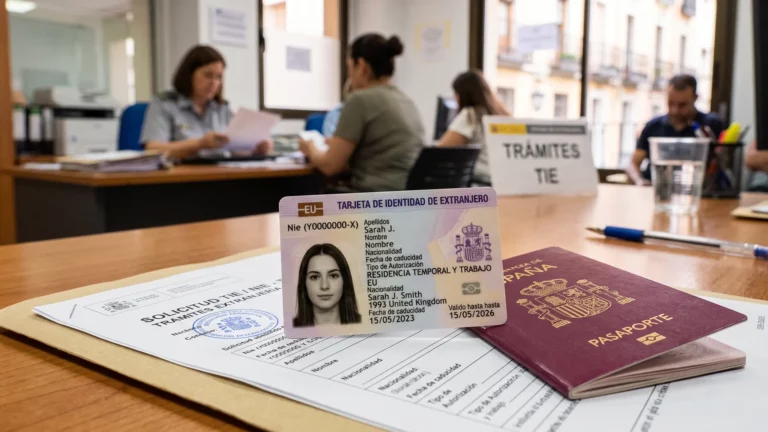
If you’re buying a property, opening a bank account or handling any kind of paperwork in Spain, sooner or later you’ll run into the same three letters: NIE. It’s not a residency permit and it’s not a visa. It’s simply the number Spain uses to identify you, and without it, nothing else can move forward.
Many foreigners discover they need a NIE number in the middle of a more urgent process — a purchase, an inheritance, opening an account — and that’s exactly when problems tend to show up: fully booked appointments, the wrong reason stated on the application, or uncertainty about whether you even need to travel to Spain to get one.
In this guide by Sol-4 Gestión, we explain exactly what a NIE number is, how it differs from a DNI, what documents you’ll need and how to apply step by step.
What Is a NIE Number and What Is It For?
The NIE, or Foreigner Identity Number, is a unique, personal number assigned by Spain’s National Police to any foreigner who has an economic, professional or social connection with the country. This number has to appear on practically any official document you sign in Spain: a property purchase contract, an employment contract, opening a bank account, or filing a tax return.
A Spanish NIE number never expires and stays the same regardless of any change in your legal status in Spain. It’s made up of a letter, seven digits and a check letter, and once assigned, it’s yours for life, even if you go years without using it.
NIE vs. DNI: What’s the Difference?
It’s common to confuse the two, but they serve entirely different purposes. The DNI is the national identity document exclusive to Spanish citizens. The NIE, on the other hand, is a tax and administrative identification number designed specifically for foreigners, and it does not prove residency or a work permit in Spain.
Having a NIE doesn’t mean you’re a resident. This is one of the most common mistakes we see: assuming that once you have the number, your legal situation in Spain is settled. They are two completely separate procedures.
Who Needs to Apply for a NIE Number
You’ll need a NIE for non-residents if you plan to carry out any of the following in Spain, even if you don’t live there full-time:
- Buying or selling a property.
- Opening a bank account.
- Signing an employment contract or registering as self-employed.
- Handling an inheritance that includes assets in Spain.
- Registering a vehicle or applying for a driving licence.
- Paying taxes as a non-resident property owner.
If your stay is going to exceed three months, applying for a NIE stops being optional and becomes a mandatory step.
Documents Required for the NIE Application
The documentation is essentially the same whether you apply for your NIE in Spain or through a Spanish consulate abroad:
- Form EX-15 (Application for Foreigner Identity Number and Certificates), completed and signed.
- Valid passport (original plus a copy of the biographical data page). EU citizens can use their national ID card instead.
- Proof of the reason for the application: a deposit contract, a property purchase deed, an employment contract, a death certificate in the case of an inheritance, or any other document supporting the economic, professional or social reason.
- Proof of payment of the fee (Form 790, code 012).
- If applying through a representative, a notarial power of attorney expressly authorising them to submit the application on your behalf.
Where and How to Apply: In Spain or From the Consulate
You have two main routes for applying for a NIE number, and which one suits you depends on your situation:
| In Spain | Spanish consulate abroad | |
|---|---|---|
| Where it’s processed | Foreigners’ Office or an authorised police station | The consular section covering your place of residence |
| Prior appointment | Mandatory, booked through the Electronic Registry | Mandatory, each consulate has its own system |
| Physical presence | The applicant or a representative with power of attorney | The applicant or a representative with power of attorney |
| Maximum legal timeframe | 5 working days from registration of the application | 5 working days from registration of the application |
| Best if | You’re already in Spain or travelling there soon | You have no travel plans in the near future |
If you’re planning to travel to Spain soon, applying there directly is usually faster. If you’re not travelling, the consular route or granting a power of attorney to a representative in Spain are the more practical options.
How to Apply for a NIE Number Step by Step
Step 1: Choose the Right Route
Decide whether you’ll process your NIE application in Spain, at the consulate in your country of residence, or through a representative with power of attorney. The reason for your application (buying a property, an inheritance, work) usually determines which route makes most sense for you.
Step 2: Book Your Appointment
Whether in Spain or at a consulate, an appointment for the NIE is mandatory. In Spain it’s booked through the Electronic Registry of the Public Administration; abroad, directly with the relevant consulate. It’s worth booking well in advance, since availability at many offices fills up weeks ahead.
Step 3: Gather the Documentation
Complete Form EX-15 and gather your passport along with proof of the reason for your application. Stating the wrong reason — for example, putting “residency” when the real reason is a property purchase — is one of the most common mistakes, and it can get your application rejected.
Step 4: Pay the Administrative Fee
Paid through Form 790, code 012, selecting the concept “Assignment of Foreigner Identity Number (NIE) at the request of the applicant.” Payment can be made in cash, by bank cheque or by card, depending on the office.
Step 5: Submit the Application
Submit the form, your passport, the supporting documentation and proof of payment at the chosen office or consulate. If you’re using a power of attorney, your representative can complete this step without you needing to be present.
Step 6: Collect Your NIE
Once resolved, you’ll be notified of the assigned number, usually by email if the process was handled through a consulate. We always recommend requesting a certified copy, since notaries, banks and the Tax Agency typically ask for one.
How Long Does It Take and How Much Does It Cost?
Spanish regulations set a maximum legal timeframe of five working days from the moment the application enters the register of the competent body. In practice, the real waiting time depends mostly on getting an appointment: some consulates, such as the one in Paris, quote roughly four to five weeks between application and delivery, while other offices resolve it faster.
As for the cost of the Administrative Fee NIE, the official fee (Form 790, code 012) is €9.84 for a first assignment, and €7.31 if it’s an update to an existing NIE. This is the same amount whether you apply for your NIE in Spain or through a consulate abroad.
What Is the NIE Certificate and How Does It Differ From a NIE Card?
The NIE certificate in Spain is the document (sometimes issued as a slip or receipt) confirming your assigned number. It’s different from the old “NIE card”: for years now, EU citizens haven’t been issued a physical NIE card, only a paper certificate showing the number. Only in specific cases involving non-EU residents is the NIE incorporated into a physical card (the TIE), which is a separate document with its own application process.
For the vast majority of foreign buyers, heirs or investors who simply need the number to operate in Spain, the paper certificate is the valid and sufficient document.
Don’t Let the NIE Hold Up Your Purchase or Your Inheritance
On its own, the NIE is just a number. What actually matters is what you need it for and what happens next. At Sol-4 Gestión, we’ve been processing NIE applications for foreign property owners on the Costa Blanca for 25 years, and most of the time our clients never set foot in a Spanish office: we handle it through power of attorney.
If your NIE is part of a property purchase or an inheritance, we make sure it’s ready exactly when that process needs it.
Frequently Asked Questions About the NIE Number
It’s a unique, personal number that identifies foreigners to the Spanish administration when they have economic, professional or social interests in the country. It does not prove residency or a work permit.
The DNI is exclusive to Spanish citizens. The NIE is the equivalent number for foreigners, intended purely for tax and administrative identification, without implying residency.
Not necessarily. You can apply through the Spanish consulate in your country of residence, or through a representative with power of attorney who processes it for you in Spain.
The maximum legal timeframe is five working days from when the application enters the register, although the real waiting time depends on getting an appointment, which can take several weeks at some consulates.
The official fee is €9.84 for a first assignment and €7.31 if it’s an update to an existing NIE.
No. The NIE is a permanent number that stays the same regardless of any change in your legal status in Spain, even if you go years without using it.
Yes. With a power of attorney expressly authorising them, your representative can submit the application, pay the fee and collect the certificate on your behalf, without you needing to travel.