If you own property in Spain, you probably already have a NIE number. But a NIE and a TIE card are not the same thing, and mixing them up is one of the most common mistakes foreign property owners make. The NIE identifies you to the Spanish administration. The TIE card, on the other hand, is a completely different document: it proves you’re legally residing in Spain, and it only makes sense to apply for one if your situation has shifted from “owner who visits their house a few times a year” to “resident.”
Many of our clients discover the TIE exists at the moment they least expect it: when applying for a non-lucrative residency visa, moving permanently to the Costa Blanca, or applying for a residency-by-investment visa. That’s exactly when the questions start: what it actually is, whether it applies to them, what documents they need, and what deadlines they have to meet.
In this guide by Sol-4 Gestión, we explain what a TIE card is, how it differs from a NIE, who’s required to apply for one, what documents you’ll need, how the application works step by step, and how renewal is handled. All backed by official sources, so you know exactly what applies to your situation before booking any appointment.
What Is a TIE Card and What Does It Prove?
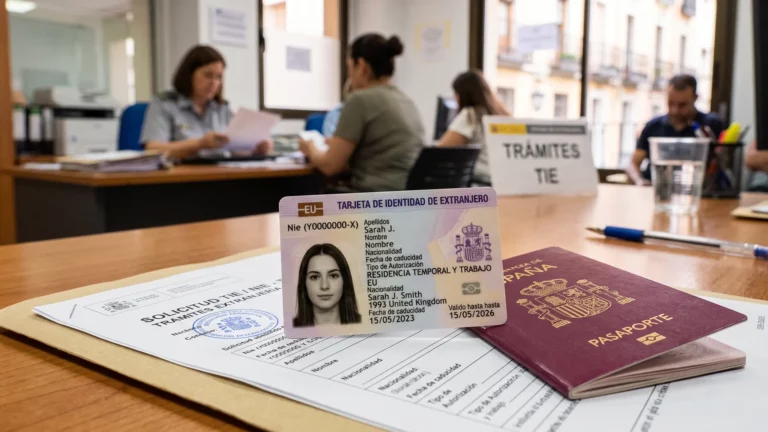
The Foreigner Identity Card (TIE) is the physical card that proves a foreign national is legally residing in Spain for a period exceeding six months. It’s issued by Spain’s National Police and includes your photograph, your NIE number, your nationality, and the type of residency authorisation you hold.
It’s worth being clear about what the TIE is not: it does not prove your identity — that’s what your passport or national ID does — it proves your administrative status in Spain. Nor is it the same as your residency authorisation: the authorisation is the official decision granting you the right to remain in the country; the TIE card is simply the physical document evidencing that right.
NIE vs. TIE: What’s the Difference?
This is the most common source of confusion, and it’s worth spelling out clearly:
- The NIE is just a number. It’s assigned automatically the first time you interact with the Spanish administration, it never expires, and it does not prove residency or a work permit.
- The TIE is a physical card, with a chip and biometric data, that does prove legal residency for over six months. It expires according to the validity of your authorisation and has to be renewed.
Put another way: everyone who has a TIE also has a NIE, but not everyone with a NIE needs a TIE. A non-resident foreign property owner who has simply bought a home in Spain has a NIE, but doesn’t apply for a TIE, because their situation doesn’t involve residency exceeding six months.
Who Needs to Apply for a TIE (and Who Doesn’t)
You’ll need to apply for a TIE card for non-residents transitioning to residency in Spain if you fall into one of these situations:
- You hold a temporary or long-term residency authorisation.
- You hold a residency and work authorisation, whether employed or self-employed.
- Your student stay authorisation exceeds six months.
- You’ve been granted international protection (asylum or subsidiary protection).
- You hold a residency authorisation through arraigo (settlement).
You don’t need a TIE if you’re an EU citizen — in that case you’re issued a Registration Certificate, not a physical card — nor if your only connection to Spain is the NIE you used to buy a property, open a bank account, or pay taxes as a non-resident.
For a foreign property owner in Spain who buys a home but keeps their habitual residence in another country, this means that, unless they apply for and obtain a residency authorisation, the TIE simply doesn’t apply to them.
Documents and Requirements for the TIE
The documentation varies slightly depending on the case, but in general you’ll need:
- Form EX-17 (TIE Application), completed and signed.
- Valid passport, original plus a copy.
- A recent passport-style photo, in colour, with a white background.
- The favourable decision on your residency authorisation, for an initial application.
- Proof of payment of the fee (Form 790, code 012).
- An updated certificate of registration (padrón), if you’ve changed address.
- Proof of Social Security registration, where applicable to your type of authorisation.
If you’re applying for a replacement due to theft, loss or damage, you’ll also need the corresponding police report.
How to Apply for a TIE Card in Spain, Step by Step
Step 1: Obtain the Decision on Your Authorisation
Before applying for a TIE, you need the favourable decision on your residency authorisation. This is the essential prior step: without a granted authorisation, there’s no TIE to process.
Step 2: Book Your TIE Appointment
A TIE appointment is booked through the Electronic Registry of the Public Administration, and it’s mandatory in every case. In higher-demand provinces, availability can fill up weeks in advance, so it’s worth booking as soon as you have the decision in hand.
Step 3: Attend Your Fingerprinting Appointment
The application is submitted in person at the National Police Documentation Unit covering your address, not at the office where you processed your residency application. On the day, your fingerprints are taken and all your documentation is verified.
Step 4: Pay the Fee
Paid through Form 790, code 012, corresponding to the issuance of the card. The amount is updated periodically, so it’s worth checking the current figure ahead of your appointment.
Step 5: Wait for Production and Collect Your Card
Once your fingerprints have been taken, the physical card takes several weeks to be produced. You’ll be notified by SMS or email when it’s ready to collect at the same police station where you submitted your application.
Deadline for Applying: The One-Month Window Many People Miss
Once the favourable decision on your authorisation has been notified, you have a maximum of one month to apply for the TIE. The deadline runs from the notification date, not from when you decide to act, and in practice the main obstacle isn’t the procedure itself, but getting an appointment in time.
If the deadline passes before you’ve secured an appointment, it’s worth keeping evidence of your attempts: delays are often not penalised if you can show you tried to apply within the timeframe, though a late application can still result in a minor administrative penalty.
How Long It Takes and How to Check Your Card’s Status
After fingerprinting, card production usually takes between thirty and forty-five days, depending on the province. During that period, the police organise production in batches (lotes): each application is assigned a number that lets you check what stage your TIE card is at before you’re notified to collect it.
While you wait, keep your application receipt: together with your passport, it serves as provisional proof of your status in Spain.
Renewing Your TIE: Don’t Confuse It With Renewing Your Residency
Renewing your TIE card isn’t the same as renewing your residency authorisation, although the two procedures often go hand in hand. If your authorisation is still valid but the card is damaged or your details have changed, you can apply for a new card without touching the authorisation. But if your authorisation has expired, you need to renew that first, and only then apply for the new TIE.
For a TIE renewal, you’ll need: a valid passport, a recent photo, the decision on the renewal of your authorisation, proof of payment of the corresponding fee, and, where applicable, proof of Social Security registration.
Don’t Let a Residency Procedure Complicate Your Situation as a Property Owner
The TIE only applies to you if your situation has shifted from buyer to resident. At Sol-4 Gestión, legal services for foreigners in Spain, we’ve spent 25 years helping foreign property owners on the Costa Blanca understand exactly which identification and residency procedures apply to them at each stage, starting with the NIE, which always comes first.
If your situation is shifting from non-resident owner to resident, we talk to you before you book any appointment, so we can confirm what you actually need.
Contact our team.
Frequently Asked Questions About the TIE Card in Spain
It’s the Foreigner Identity Card, a physical document proving you’re legally residing in Spain for over six months. It’s issued by Spain’s National Police.
The NIE is just a tax identification number that never expires and doesn’t prove residency. The TIE is a physical card that does prove legal residency and that expires according to the validity of your authorisation.
No, unless they apply for and obtain a residency authorisation lasting over six months. If you’re simply buying a property, opening an account, or paying taxes as a non-resident, the NIE is enough.
One month from the notification of the favourable decision. It’s a strict deadline, though in practice delays are usually not penalised if you can show you tried to book an appointment within that period.
At the National Police Documentation Unit in your province, by appointment through the Electronic Registry. It’s not processed at the immigration office where you handled your residency application.
Between thirty and forty-five days from fingerprinting, depending on the province. You’ll be notified by SMS or email when you can collect it.
By presenting a valid passport, a recent photo, the decision on the renewal of your authorisation, and proof of payment of the corresponding fee. If your authorisation has expired, it needs to be renewed first.